The Importance of ESG for Net Lease REITs
While net lease REITs have developed robust governance policies and social initiatives, environmental has been more difficult to address. Learn why and how to approach
Nearly three-quarters of institutional investors are factoring ESG into their investment decisions, up 18% since 2019 according to a recent report. As the importance of responsible investing continues to grow and more investors evaluate companies based on ESG-related criteria, REITs are recognizing both the benefits and necessity of a holistic ESG strategy.
Despite the increased focus, the net lease industry has lagged behind. In a recent WMRE survey focused on the net lease sector, only six percent of respondents said ESG was a significant factor in their investment decisions. While net lease REITs have developed robust governance policies and social initiatives, environmental has been more difficult to address—largely due to the triple-net lease structure whereby tenants are responsible for the day-to-day operations of the property, including energy usage and environmental practices.
While net lease REITs don’t directly control property operations, there is an enormous opportunity to work with tenants to reduce their environmental impact and implement sustainability initiatives to support the ‘E’ in ESG—here’s how.
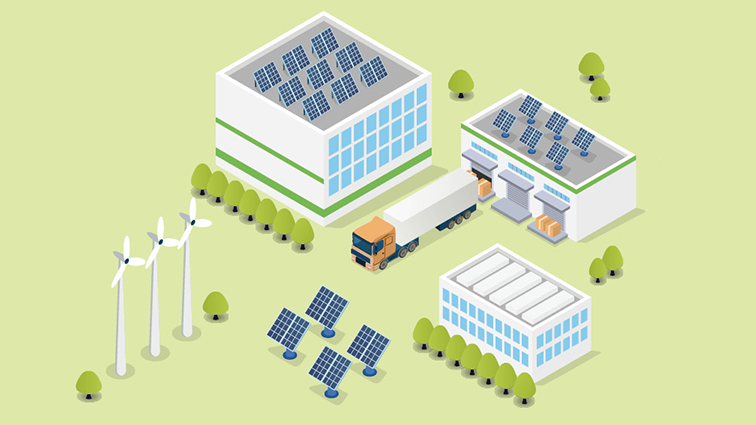
Integrate ESG into underwriting
ESG criteria can be integrated into the underwriting of new investments both at the property and tenant levels. In assessing properties, factors to consider are the types of energy used, equipment age and waste management standards. Most importantly, considering not only the current state of the building, but what improvements can be made in the future, is critical. On the tenant level, it’s important to understand the company’s broader ESG goals and ensure they are committed to reducing their carbon footprint. For build-to-suit investments—where REITs fund the construction of a new facility— taking a proactive approach to engaging with tenants on sustainable design decisions early in the process is crucial and a great way to turn a conventional investment into a green one.
Source sustainability projects from within
Net lease REITs can source sustainability-focused opportunities from their own portfolio. REITs with industrial properties are particularly well suited to working with tenants on sustainability projects that improve carbon footprint, reduce operating expenses and enhance asset quality. Such projects include, renewable energy opportunities, green building certifications (ie. LEED, BREEAM), building efficiency retrofits or energy audits. By identifying owned properties best suited for certain projects and proactively reaching out to tenants, net lease REITs can build a steady pipeline of sustainable investments while helping tenants decrease operating costs and advance their environmental goals.
Finance investments through green bonds
As more investors look to increase their allocation to ESG-related investments, public net lease REITs may be able to secure attractive financing to fund their pipeline of sustainable investments through the issuance of green bonds. Green bonds are designed to support strategies and initiatives that have a positive environmental benefit and can help net lease REITs appeal to a wider investor base and raise the capital needed to fund green investments.
In closing
Implementing environmental initiatives as part of a broader ESG strategy is possible for all REITs, net lease included. At W. P. Carey, we take a proactive approach to reducing our global carbon footprint, partnering with our tenants to reduce their environmental impact and meet their own ESG goals. These initiatives are not only beneficial to the planet, but to a REIT’s broader portfolio. Green buildings generally increase property value, drive higher rents, attract higher-caliber tenants and often improve renewal outcomes, which can all lead to enhanced cost of capital and accelerated growth.

Related Topics:
You May Also Like:

The Appeal of Industrial Sale-leaseback Transactions
Let’s start with the foundation: if you’re unfamiliar with the term sale-leaseback, you should go here. For a more focused explanation relating to industrial properties, let’s turn to Erik Foster, principal with Avison Young and head of the firm’s industrial capital markets practice. “A sale-leaseback is when a user of real estate who owns their premises chooses to monetize that real estate. They stay in [the property], occupy it for a long term and sell it to a third-party owner who becomes the landlord, and the occupier becomes a tenant,” Foster told LoopNet. According to Foster, sale-leaseback transactions for industrial assets have been surging over the past several years, with interest in North American industrial properties emanating from across the world. “It’s truly become a global marketplace,” Foster said. This interest in industrial real estate is neither new nor particularly surprising. As Foster noted, the sector has been experiencing record low vacancies amid historic levels of investment activity. And these factors, which have intensified during the pandemic, have created what Foster described as “a very exuberant investment atmosphere.” And industrial users are increasingly taking note of this enthusiasm. Historically, industrial users have been more apt to own their facilities than their office or retail counterparts. Where most office and retail properties are typically developed with the expectation that multiple tenants will occupy the property, some types of industrial properties are more commonly utilized by a single user. Moreover, industrial properties are often heavily customized to meet the manufacturing or specialized logistical requirements of a particular business. But industrial users are beginning to realize that they may be able to possess their proverbial cake and consume it too. “Industrial users are finding that they can reap the rewards of the sale of their building at record pricing, but still maintain occupancy and the use, so nothing really changes for them,” Foster said. Of course, few things in commercial real estate are without caveats. To gain a better understanding of the industrial sale-leaseback phenomenon, LoopNet spoke with Foster — as well as Gino Sabatini, head of investments and managing director of W. P. Carey — and they walked us through the attributes and challenges of this process for both users and investors. An Opportunity for Industrial Users to Acquire Capital and Flexibility According to Foster, for the industrial user, most of the advantages of a sale-leaseback transaction can be reduced to two concepts: working capital and flexibility. Foster noted that most industrial users that own their property have some kind of financing tied to the building. Perhaps they have a loan that represents 50%, or even 60% or 70% of the building’s appraised value. This loan provides them with operating capital to reinvest into the business — for the purchase of equipment or materials, for instance. Through a sale-leaseback transaction, a user can derive 100% of the value of their property, and reallocate that capital to other aspects of their business. Depending on the company’s accounting structure, this could vastly improve their balance sheet. “You can pay down debt, you can reinvest into your business,” Foster said. Meanwhile, the company in question retains use of the asset. The user “gets a ton of capital out of the real estate and continues to use [the real estate] the way they always have,” Foster added. The industrial user also enhances their flexibility in the process, trading their real estate asset for “a leasehold obligation. It’s not an illiquid asset,” Foster said. Between record-setting industrial investment activity and equally historic low interest rates, this can seem like the ideal moment for industrial users to relinquish ownership of their facilities. “W. P. Carey, and most other sale-leaseback and net-lease buyers, operate on a spread over interest rates,” Sabatini said. This means that as interest rates potentially rise in the near(ish) future, cap rates could climb alongside them. Currently, Sabatini said that cap rates range from 4% to 7%, depending on the location and nature of the facility (more on that in a moment). Foster said that he was even “hearing about sub-3% cap rates on the coasts.” All of these factors may make an industrial sale-leaseback transaction seem like a “best of both worlds” scenario for the user, but it’s not quite that simple. For one thing, as most industrial users are typically real estate novices, they need to make sure they carefully consider all potential suitors. “The user needs to make sure that they don’t talk to the first person that knocks on the door,” Foster said. According to Foster, taking the property through a traditional investment sales process generally garners terms that are more beneficial to the user — both for the sale and the subsequent lease. “When we go out and we make a market for assets like this, we’re amazed at how the terms continue to become better as we work through the process. Foster mentioned that it’s also important to find the right investor match for each particular industrial user. “Sometimes this is their only location and its critical to the [tenant/seller], so having an owner who doesn’t have any forethought or care about the user is an issue too, so you’ve just got to find the right match.” Industrial users also need to be comfortable with the control they’re surrendering by entering into a sale-leaseback transaction. For users that are accustomed to having sole authority over their premises, that adjustment could potentially be challenging. And, as frenetic as the industrial sales market is at the moment, there are reasons to believe that prices could continue to rise. “With the shortages in the commodities markets and the difficulty in getting steel and lumber and other materials, there’s a bit of a governor on the amount of development that can happen. So, the supply of assets is also muted, which is continuing to drive scarcity pricing,” Foster said. Ultimately, the viability of a sale-leaseback transaction for an industrial user will come down to that particular company’s priorities and whether they value working capital and flexibility over control and security. For investors, the calculus is a bit more fraught with risk, but potentially equally rewarding. Conducting Due Diligence on an Industrial Sale-Leaseback Opportunity It’s probably fair to say that W. P. Carey has more experience in industrial sale-leasebacks than any other property owner; after all, that’s been the firm’s primary focus since it was founded in 1973. As Sabatini described it, “Sale-leasebacks of industrial buildings for sub-investment grade companies is really our bread and butter.” When LoopNet asked what made these investments so appealing to W. P. Carey, Sabatini explained, “The facilities are often very critical to the company that is doing the sale-leaseback, and that’s very important for us; because we’re a long-term holder and we want to own something that the company is planning on using for a long period of time.” In an ideal scenario, Sabatini said that W. P. Carey’s investment thesis is relatively simple. “We’re making a bet alongside the equity investors in that company that the company is going to be successful for a long period of time. If we’re correct, then we’ll collect rent for a 15- or 20-year primary lease term for starters, and potentially [execute] renewals as well.” But what happens if they're wrong? According to Sabatini, that depends largely on the market and asset in question. A highly customized property, one that will be challenging to adapt for a new tenant — such as a food or biotech manufacturing facility — represents a greater risk than a relatively generic property, like a last-mile fulfillment center. That risk expands in smaller markets and is somewhat ameliorated in larger markets. In terms of how Sabatini approaches the due diligence process, he said that the first portion of his methodology involves elements that are fairly consistent across any real estate asset class or deal type. He advised that prospective investors commission an environmental phase I study (and a phase II study if the initial report reveals any areas for concern); have an engineer walk the property to appraise its structural integrity; and review the property survey and title. “Make sure you’re purchasing a clean piece of real estate,” Sabatini said. After that, you need to undertake what Sabatini says is often the more challenging facet of the process: reviewing the company who will first sell you the property and then become your tenant. Sabatini likens this phase of due diligence to the process credit organizations like Moody’s undertake when they’re rating companies. “You try to understand the industry, the company’s position within it, as well as any threats to either the company or the industry,” he said. “You really need to dig into the credit and understand why the building is important to the company, and what the company’s financial prospects are in the short-term, the medium-term and the long-term.” Sabatini also said that it’s important to carefully review the company’s balance sheet. Specifically, you should assess their attitude towards leverage and how they have fared during downturns. As this process illustrates, in many respects a sale-leaseback transaction isn’t a simple real estate deal; it’s more analogous to the creation of a (hopefully) long-term, mutually beneficial partnership.

Sale-leasebacks Are Back!
The sale-leaseback market is booming. Strong fundamentals including low interest rates, outsized demand for high-quality assets, an active M&A market and significant amounts of capital driven by cheap debt and strong currency make now an opportune time for sellers to execute a sale-leaseback and unlock otherwise illiquid capital tied up in their real estate. According to data from SLB Capital Advisors, sale-leaseback activity increased 17% in Q2 from the previous quarter, reaching $3.6 billion–the second highest in terms of deal volume since before the pandemic in Q4 2019. With interest rates unlikely to rise in the short term and property valuations being pushed higher as new investors enter the sale-leaseback market, we expect this high level of activity to continue into 2022. However, within the broader sale-leaseback market, each core property type–industrial, office and retail–faces unique headwinds and tailwinds, presenting new challenges and opportunities across each. Here’s how we think each will fare in 2022. The Industrial Surge The industrial real estate market continues to be one of the strongest sectors fueled by tailwinds related to the growth of e-commerce, including increased inventory requirements and record-low vacancy rates. These strong fundamentals mean that investor demand for industrial sale-leasebacks will only increase, particularly as new entrants enter the market. We are already seeing the effects of this–but as more entrants enter, the imbalance between the product available and demand for assets will continue to widen, driving prices higher and cap rates lower–even in traditionally non-core industrial markets. In addition, a lag in new development due to increased material and labor costs will keep real estate valuations for existing assets high. As a result, we don’t see the industrial market slowing any time soon–creating immense opportunity for sellers to maximize the value of their real estate through a sale-leaseback. Growing Office Optimism While office has certainly been a dark horse in the real estate market due to lockdowns and work-from-home mandates, there’s some optimism on the horizon going into 2022. Several big tech companies such as Google, Facebook and Amazon, have made investments in NYC office space this year, sparking early signs of recovery in the sector. In addition, Sun Belt markets such as Texas and Florida–where many urbanites migrated during the pandemic–are seeing an increase in demand for offices supported predominantly by the small and mid-size businesses located in those regions. For potential sellers, these are all positive signs and suggest that investor demand for certain office assets will rise in 2022, particularly for high-quality properties in strong markets leased to investment-grade tenants. Retail's Road to Recovery Similar to the office market, retail is seeing a recovery from COVID-19 pandemic lows. Retail foot traffic and sales continue to increase, but the rise of e-commerce has certainly left a lasting impact on the industry as a whole, as most retailers are now implementing hybrid store models which include both brick-and-mortar stores and online distribution. In the next few years, many retailers will likely reevaluate their portfolios in terms of number of stores, location and use–and many may downsize as online orders become a greater proportion of their sales. As a result, the overall level of occupied retail space will likely shrink, meaning the market will favor corporate sellers and tenants. In addition, we expect investor demand for essential retail such as grocery and quick-service-restaurants will remain strong in 2022, as those sectors have demonstrated exceptional resiliency during the pandemic and resulting economic downturn. We’ll likely also see an increase in volume of retail sale-leasebacks in Europe, particularly for those essential assets, as US-based investors expand into new markets to take advantage of different costs of capital. What's Next Overall, the outlook for sale-leasebacks remains positive across all three core property types, with 2021 shaping up to potentially be a record year for deal volume. As long as the market fundamentals remain strong, corporate sellers pursuing a sale-leaseback will be able to secure high valuations for their real estate assets while locking in current low rates for the long term. Working with an experienced sale-leaseback investor such as W. P. Carey ensures sellers unlock 100% fair market value of their assets–which can be reinvested into growth initiatives–and also provides a long-term capital partner that can support future real estate needs.