Five Milestone Moments to Commemorate Five Decades of Investing for the Long Run®
This year marks W. P. Carey’s 50th anniversary, the company’s most exciting milestone yet. Throughout its history, the company has gone through different stages on its journey from a small, privately held investment management firm to a $24 billion publicly traded REIT – but through all the twists and turns, at its core has remained dedicated to Founder Wm. Polk Carey’s commitment to Investing for the Long Run. To commemorate five decades, W. P. Carey reflects on five defining moments in its history and celebrates how far it has come since its humble beginnings. Raise a glass and cheers to #50yearsofWPC!
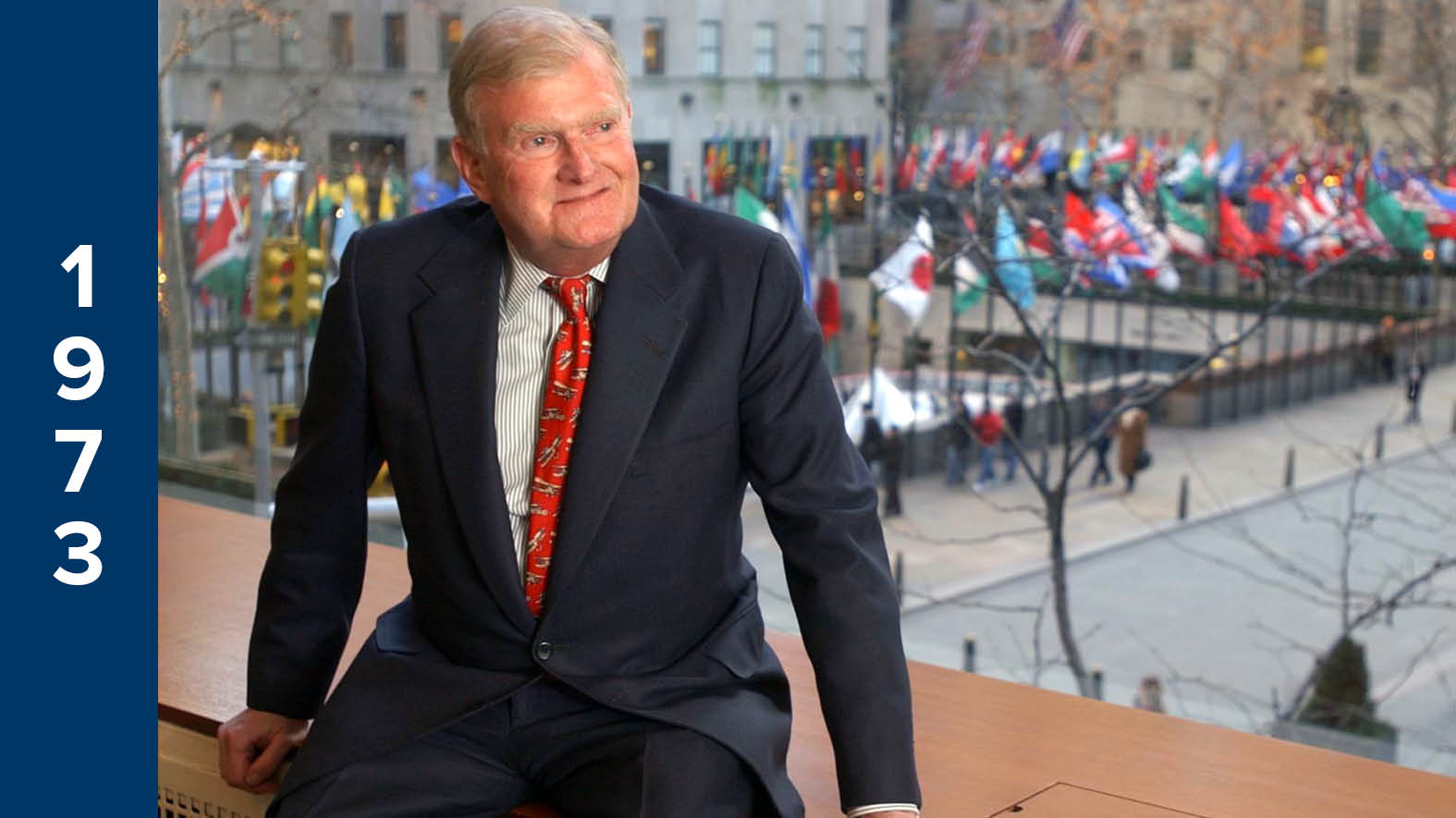
1. W. P. Carey & Co is founded by Bill Carey
W. P. Carey Founder Bill Carey was a born entrepreneur. As a child he sold soda and writing ink he made in his basement to his neighbors. When he arrived at college to begin his freshman year, he soon discovered he owned something many of his schoolmates did not – a small dorm room refrigerator. Seeing an opportunity, he purchased as many refrigerators as he could afford and leased them to his schoolmates for a small fee. By the end of his sophomore year, he had made over $10,000.
This simple idea laid the groundwork for the founding of W. P. Carey (then W. P. Carey & Co) on April 3, 1973. Through W. P. Carey, his goal was twofold; to support growing companies with an immediate cash infusion through the purchase of their real estate and to provide individual investors with the opportunity to easily invest in income-producing real estate without the significant financial burden of purchasing an investment property.
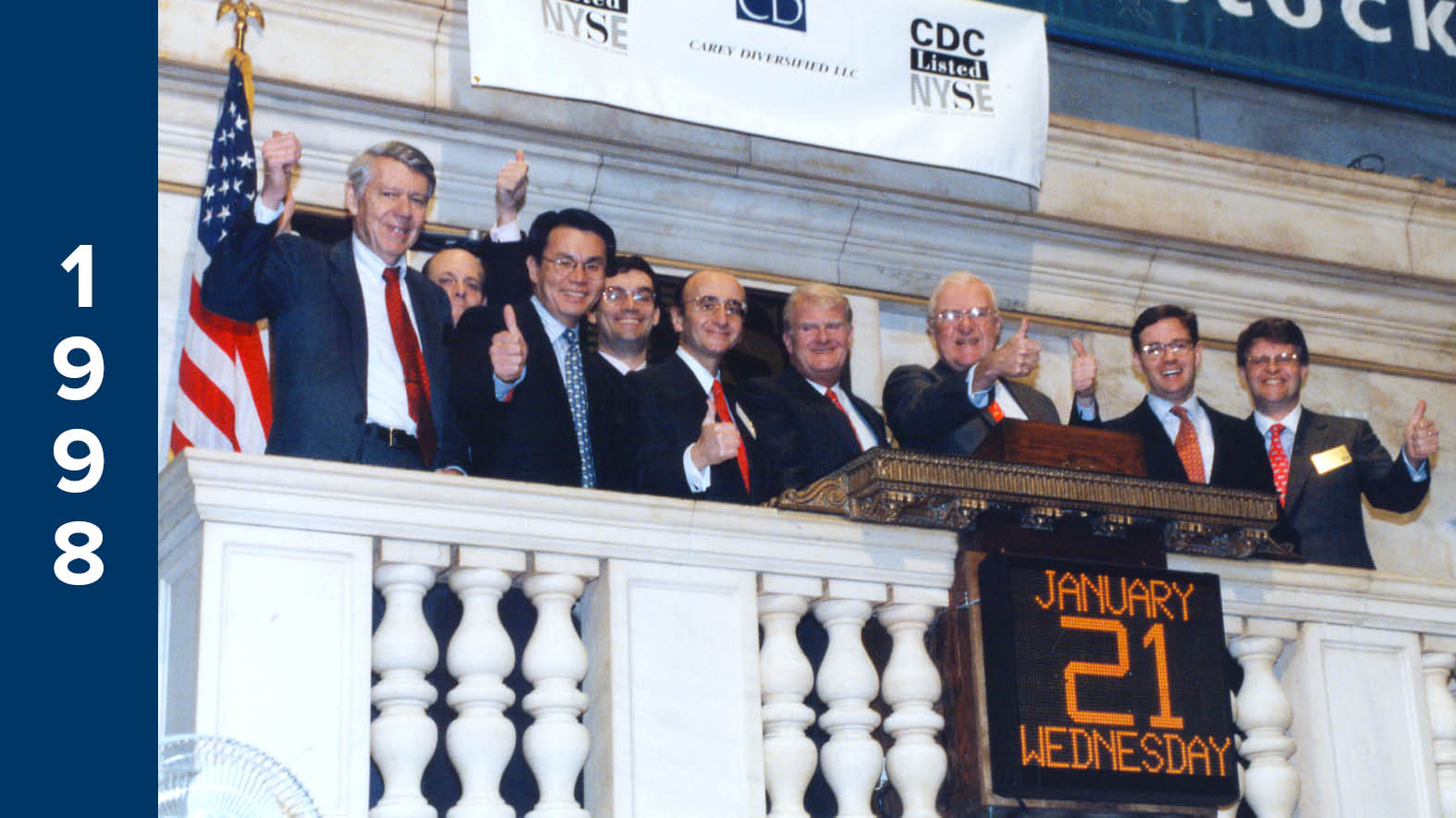
2. W. P. Carey Begins trading on NYSE
On January 21, 1998, Carey Diversified LLC – the consolidation of Corporate Property Associates 1-9 which would later merge with W. P. Carey & Co to become W. P. Carey – began trading on the New York Stock Exchange under the ticker symbol “CDC” (now “WPC”). When the company started trading, it had a portfolio of 198 properties in 37 states. This milestone made W. P. Carey accessible to all investors and broadened the company’s opportunities for future capital. It was also the year W. P. Carey issued its first dividend, laying the foundation for its reputation today as a reliable income-producing stock. This year, W. P. Carey celebrated 25 years of trading on the NYSE!

3. W. P. Carey expands to Europe with opening of its London office
In 1999, W. P. Carey expanded into Europe with the opening of its London office. This launched a whole new avenue of investment opportunities and reinforced the company’s commitment to diversification – now across geography, in addition to property type and tenant industry. W. P. Carey was among the pioneers of the sale-leaseback model in Europe, helping to introduce the financing tool and its benefits for corporate owner-occupiers seeking capital. In 2008, W. P. Carey further grew its European foothold with the launch of its Amsterdam office. To date, W. P. Carey has invested over €8 billion in Europe, building a portfolio of more than 600 European assets across 20+ countries.

4. W. P. Carey converts to a REIT
On September 28, 2012, W. P. Carey converted to a Real Estate Investment Trust. Somewhat limited by its existing structure, the REIT conversion helped increase the company’s visibility and expanded its access to institutional capital. As a result, W. P. Carey was able to significantly increase the size of its portfolio, grow dividends and diversify its shareholder base with both active and passive REIT investors. In 2014, the company completed its inaugural public equity and US bond offerings and received investment-grade ratings from Moody’s and S&P.

5. W. P. Carey concludes its exit from the non-traded REIT business
On August 1, 2022, W. P. Carey announced the completion of its merger with its final Corporate Property Associates program, CPA®:18 – Global. This marked the exit of the company from the non-traded REIT business, effectively completing its transition to a pure-play net lease REIT. This transition enabled W. P. Carey to not only simplify the business, but become a more valuable company with improved earnings quality, enhanced size and scale, improved cost of capital and a strong, more flexible balance sheet. Today, this enables W. P. Carey to focus on generating long-term earnings growth and delivering long-term value to its shareholders.
Closing Thoughts
While reflecting on all that’s been accomplished over the past 50 years, it’s important to also note that W. P. Carey’s future has never looked brighter! With a team of talented and dedicated employees and a simpler, stronger company, W. P. Carey is poised to continue delivering on Bill Carey’s mission of Investing for the Long Run for many years to come.
Related Topics:
You May Also Like:

How Real Estate Partnerships Can Accelerate Sustainability Progress
As companies navigate a rapidly changing business environment, sustainability is increasingly shaping real estate decisions. Many organizations are looking for ways to reduce energy consumption, lower emissions, strengthen resilience and modernize facilities without diverting capital from business growth. Yet sustainability initiatives often compete with other strategic priorities. Companies may see opportunities to improve efficiency or invest in renewable energy but hesitate to commit resources that could otherwise support growth or core operations. We believe making real estate more sustainable is an ongoing process that requires collaboration, flexibility and a long-term approach. Carey Tenant Solutions formalizes that commitment by helping our tenants address evolving real estate needs even after an acquisition or sale-leaseback transaction is complete. For tenants, that support can take many forms, from identifying operational improvements to funding projects that help facilities perform better over time. A long-term ownership mindset W. P. Carey’s long-term ownership approach means we view each transaction as the beginning of a partnership. Through regular dialogue, property visits and ongoing asset management, we develop a deep understanding of tenants’ operations and priorities, helping identify opportunities to improve facility performance and advance sustainability goals. This long-term approach allows us to continue supporting tenants as their businesses evolve. In 2017, W. P. Carey provided build-to-suit financing for an industrial facility in Poland leased to Ontex, a leading global supplier of personal hygiene products. Several years later, we partnered with Ontex again to fund a 460,000-square-foot expansion, enabling the company to consolidate production operations from multiple European locations into one modern facility. The expanded portion of the facility received a BREEAM "Very Good" environmental certification, demonstrating how Carey Tenant Solutions and a long-term partnership approach can support both business growth and sustainability objectives. Energy solutions built around tenant needs No two tenants have identical sustainability goals. As a result, flexibility is essential. Through Carey Tenant Solutions, W. P. Carey helps tenants evaluate and implement projects tailored to their operations and objectives. These initiatives can include energy efficiency retrofits, smart building technologies, electric vehicle charging infrastructure and other sustainability-focused improvements. Through our CareySolar® program, W. P. Carey partners with tenants on a variety of solar solutions designed to help our tenants lower utility costs and reduce greenhouse gas emissions. One example is our work with an industrial tenant in Illinois, where we managed the installation of a 1,350-kW rooftop solar array as part of a lease extension. The project was designed to provide the tenant with access to clean energy while lowering carbon emissions and energy costs at one of its most important facilities. These investments can create benefits beyond sustainability. Energy-efficient facilities may help lower operating expenses, improve tenant experience and support long-term building performance. Looking ahead As Climate Week brings together business leaders, policymakers and sustainability professionals to discuss the future of the built environment, one theme remains clear: meaningful progress requires partnership. Real estate owners and occupiers can achieve more when they work together. Through Carey Tenant Solutions, we're helping tenants expand and modernize facilities, improve energy performance and advance sustainability initiatives, while allowing them to preserve capital for the investments that drive their businesses forward.

An Interview with Gino Sabatini
Gino Sabatini, our Head of Investments, was recently a guest on the Net Lease Observer podcast. In the podcast, Gino discusses: His background in the restaurant business The history of W. P. Carey His view on how the investment market has changed over the years; and His outlook for 2026 and beyond Watch now An interview with Gino Sabatini, W. P. Carey, and Sean Hostert, Net Lease Observer.

Flexible Solar Solutions Built Around Tenant Needs
As energy costs rise and decarbonization becomes an increasingly important business priority, many companies are exploring solar—but not every project looks the same. Through CareySolar, part of the energy solutions offering within Carey Tenant Solutions, we provide multiple pathways for solar adoption, helping tenants reduce operating costs and advance their sustainability objectives. Our approach is intentionally flexible, enabling close collaboration with tenants on solar strategies that align with their operational preferences and long-term goals. Tenants can take advantage of this offering through several project types: Landlord-Owned Solar: Turnkey Solutions with No Upfront Tenant Capital For tenants seeking the benefits of on-site renewable energy without the complexity of ownership, W. P. Carey can fund, design, install and maintain the solar system. Our turnkey solutions allow tenants to access on-site solar with no upfront capital investment or operational responsibility. W. P. Carey will sell electricity generated by the system to the tenant, which can significantly reduce tenants’ utility expenses, provide greater energy price stability and support corporate sustainability objectives. For example, in 2024, W. P. Carey entered into a power purchase agreement with an existing tenant, a healthcare products distributor, to fund and manage the installation of a roof-mounted solar system. The system became operational and began generating power in early 2025, offsetting approximately 90% of the building’s total power consumption. As a result, our tenant was able to significantly reduce its carbon footprint and utility costs without deploying upfront capital. Community Solar: Unlocking Value from Tenant Rooftops In addition to traditional solar, we can partner with tenants to develop community solar projects directly on their rooftops, transforming underutilized space into a shared renewable energy resource that generates power for the surrounding community. This energy is usually sold at a discount to both the tenant and local subscribers, reducing utility costs while also improving grid resilience and reliability. Another option is that tenants can receive Renewable Energy Certificates (RECs) from the system to offset their annual power consumption. Rooftop community solar represents another way we deliver creative energy solutions that benefit tenants, communities and our portfolio. We recently entered into an agreement with our tenant, a grill manufacturer, to manage and fund the construction of a 6.1 MW rooftop community solar system at their leased facility. Upon completion, the solar installation is expected to generate enough power for an estimated 580 homes in the surrounding community. Tenant-Owned Solar: Flexibility to Build, Own and Operate W. P. Carey also offers tenants the flexibility to build and own on-site solar systems, giving them full control over their projects. We partner closely with tenants to enable solar development at their leased facilities, allowing them to customize system design, capture available economic incentives and seamlessly integrate solar into their broader energy strategy. We supported our tenant, Sonae MC, on the installation of a 3.1 MW solar roof on their leased facility in Portugal. The solar roof offsets approximately 35% of the building’s annual consumption and thus significantly reduces the facility’s electrical power grid needs, helping Sonae save on energy costs. A Partnership Approach to Energy Solutions Solar is not a one-size-fits-all solution. Carey Tenant Solutions is designed to meet tenants where they are and evolve alongside their needs. By combining capital, real estate expertise and a long-term ownership mindset, we help tenants pursue practical, scalable energy solutions that support their long-term goals.